


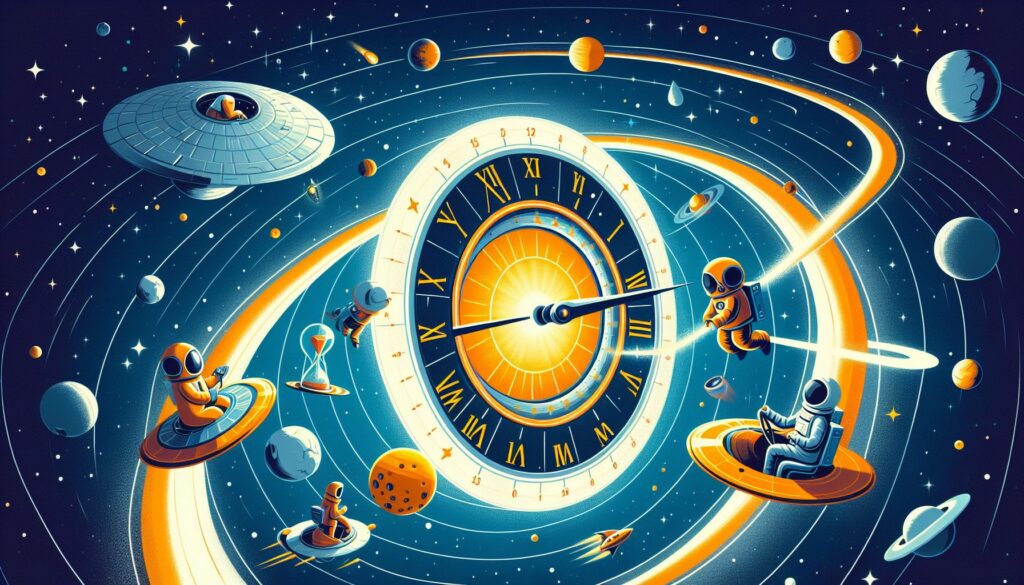
Introduction
Have you ever wondered why time behaves differently when you are in space? This phenomenon may seem perplexing at first, but there are scientific explanations behind it. In this article, we will delve into the reasons why time passes more slowly in space compared to Earth.
Time Dilation in Space
The concept of time dilation, as described by Einstein’s theory of relativity, is a fundamental principle that governs the behavior of time in different frames of reference. When an object is in motion or experiencing a strong gravitational field, time will appear to pass more slowly relative to an observer in a different frame of reference.
In the case of space travel, astronauts experience both forms of time dilation. As they move at high speeds and are exposed to weaker gravitational forces compared to Earth, time slows down for them. This means that while they may feel like they have been in space for a certain duration, more time would have actually passed on Earth.
Effects of Time Dilation
The effects of time dilation may seem like a concept out of science fiction, but they have been proven through experiments and observations. For example, atomic clocks flown on airplanes or placed in satellites have been found to run slightly faster than clocks on the ground due to their relative motion and weaker gravitational pull.
In space, where the effects of time dilation are more pronounced, astronauts experience a noticeable difference in the passage of time. This phenomenon has practical implications for space travel, as it means that astronauts age slightly slower than people on Earth. While the effect is minimal for short missions, it could become more significant for longer journeys to distant planets or stars.
Link to relevant website: https://www.nasa.gov/audience/forstudents/k-4/stories/nasa-knows/what-is-relativity-k4.html
Understanding the Science Behind Time Dilation
To understand why time dilation occurs in space, we need to consider the fundamental principles of Einstein’s theory of relativity. According to this theory, time and space are interwoven into a single continuum known as spacetime. Gravitational fields, as well as the motion of objects, can warp this spacetime, causing time to behave differently depending on the observer’s frame of reference.
In the case of space travel, the high speeds at which astronauts travel near the speed of light cause time to slow down relative to Earth. Additionally, the weaker gravitational field in space further accentuates this effect, leading to a significant difference in the passage of time between astronauts in space and people on Earth.
Practical Implications of Time Dilation
The effects of time dilation may seem theoretical, but they have real practical implications for space exploration. For instance, communication between astronauts in space and mission control on Earth needs to account for the time difference to ensure that commands and responses are synchronized. Furthermore, the long-term effects of time dilation on astronauts’ health and aging need to be studied to support future space missions.
Link to relevant website: https://www.space.com/29859-the-mystery-of-time.html
Conclusion
In conclusion, the phenomenon of time dilation in space is a fascinating aspect of physics that has profound implications for our understanding of the universe. By unraveling the mysteries of time and space, scientists can pave the way for future space exploration and unraveling the secrets of the cosmos.
To learn more about Mengapa Waktu Berjalan Lebih Lambat Saat Berada di Luar Angkasa, visit Vigli.org.